Active Research
Active Research
Robert Fithen’s current research direction has shifted decisively toward finance: applying decades of work in numerical methods, computational modeling, machine learning and empirical simulation to portfolio construction and historical-data portfolio testing.
From computational engineering to finance
The same computational habits that drive finite element analysis, CFD, adaptive numerical methods, and high-performance simulation now guide the finance research program: specify the model, define constraints, run the computation, test the assumptions, and evaluate results through repeatable historical tests.
This work seeks to make portfolio research systematic, documented, and computationally testable. Rather than treating finance as a purely qualitative judgment problem, the research frames portfolio design as an applied computational problem with explicit inputs, constraints, objective functions, and validation steps.
Portfolio Computational Methods
Methods for building, testing, and refining portfolios through numerical optimization, historical simulation, machine learning signals, turnover constraints, robustness checks, and repeatable implementation rules.
Expanded Portfolio Theory
EPT extends the portfolio-theory research path toward a broader computational framework for portfolio selection, constraint handling, risk evaluation, and implementation-sensitive allocation.
HiFuPi Backtesting
Current backtesting work applies EPT ideas using the new HiFuPi asset model, emphasizing structured historical tests, asset-selection logic, and computationally reproducible portfolio experiments.
5thN Financial
The research direction is connected to Robert Fithen’s role as CEO of 5thN Financial, where finance, computation, portfolio methodology, and practical implementation come together.
Expanded Portfolio Theory / EPT
Expanded Portfolio Theory is the central finance-research theme. The work builds from classical portfolio theory but places greater emphasis on the computational details that determine whether a portfolio method can be implemented, tested, and repeated in realistic settings.
Key themes include:
- constraint-aware portfolio construction,
- robust and stable allocation rules,
- portfolio behavior under turnover and holding restrictions,
- empirical simulation and historical simulation,
- machine-learning-informed asset signals,
- implementation discipline rather than ad hoc portfolio changes.
Why EPT fits the research path
EPT is a natural extension of a career spent in engineering mechanics and scientific computing. It treats portfolio construction as an engineering-style problem: identify the governing assumptions, compute the solution, test sensitivity, and evaluate model behavior under controlled historical experiments.
What makes it practical
The work emphasizes algorithms that can be backtested, audited, and implemented. This helps connect theory to actual portfolio-management decisions at 5thN Financial while preserving the discipline of a research program.
HiFuPi asset-model testing
A major current effort is backtesting EPT with the new HiFuPi asset model. The goal is to evaluate how an EPT-driven process behaves when portfolio construction is tied to a defined asset model, a repeatable selection process, and historical market data.
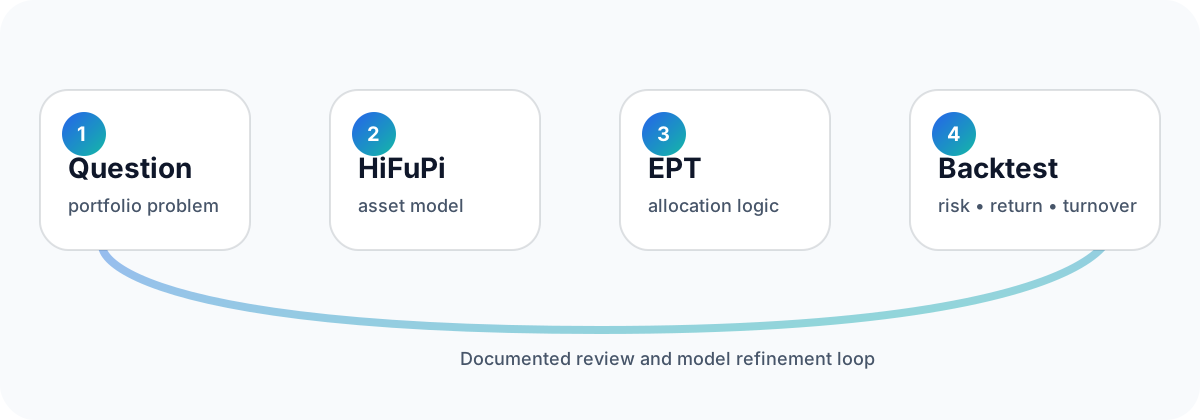
The backtesting program is organized around a research pipeline:
- define the portfolio question,
- build the HiFuPi asset universe and input model,
- apply EPT allocation and constraint logic,
- run historical backtests,
- evaluate risk, return, turnover, stability, and implementation quality,
- refine the model only through documented research rules.
Questions guiding the work
- How does EPT behave when realistic constraints are applied?
- Which parts of portfolio performance come from asset selection, allocation rules, turnover discipline, or the HiFuPi model itself?
- Can backtesting be made transparent enough that each performance claim is tied to an explicit computational process?
- How can portfolio methodology preserve the rigor of engineering computation while remaining practical for real-world advisory work?